Guide
How to date a handwritten letter with no date on it
To date a handwritten letter with no date, use the clues it carries. Many family letters give only “Sunday” or “Tuesday evening”. A date is rarely written down, but it is usually recoverable: the envelope, the weekday, the events mentioned and the paper itself all narrow it. Work from the strongest clue to the weakest, and record how sure you are.
The short answer
To date a letter with no date, work through five clues in order: the postmark or envelope, the weekday against a perpetual calendar, holidays and events named in the text, the old date styles the writer used, and finally the paper and handwriting. Write down a range and your reasons, not a single guess.
Dating a letter from a clue in the text
Cover the date on Abraham Lincoln’s letter to Mary. Near the foot of the page he says that Wickliffe ran for governor of Kentucky and lost. The election returns in the Tribune Almanac list Wickliffe and Bramlette in the 1863 governor’s race. An undated copy with that passage could be catalogued as “after the 1863 Kentucky election.” The election alone gives no exact day.
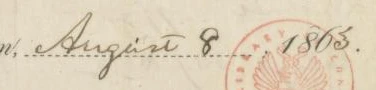
Transcribe your own letter and look for an election, a wedding or another event you can date independently.
1. Start with the envelope
A postmark can give a place and a day, and a stamp gives a rough range of years. If the envelope is missing, look at the letter for a return address or a note such as “Sent with Joe”, which means it never went through the post. Photograph both sides of every sheet so these clues stay with the letter.
US letter rates by year
If the envelope still has its stamps, add up the postage and compare it with the basic rate. These are the official US rates for a first ounce of ordinary mail.
| Letter mailed | Basic US letter rate |
|---|---|
| July 1863 to September 1883 | 3¢ (per half-ounce) |
| October 1883 to June 1885 | 2¢ (per half-ounce) |
| July 1885 to November 1, 1917 | 2¢ |
| November 2, 1917 to June 1919 | 3¢ |
| July 1919 to July 5, 1932 | 2¢ |
| July 6, 1932 to July 1958 | 3¢ |
| August 1958 to January 6, 1963 | 4¢ |
| January 7, 1963 to January 6, 1968 | 5¢ |
| January 7, 1968 to May 15, 1971 | 6¢ |
| May 16, 1971 to March 1, 1974 | 8¢ |
| March 2, 1974 to December 30, 1975 | 10¢ |
| December 31, 1975 to May 28, 1978 | 13¢ |
| May 29, 1978 to March 21, 1981 | 15¢ |
Treat a match as a lead. Heavy letters, airmail and special services cost more, local mail could cost less, and people used old stamps for years. A ZIP Code in the address means 1963 or later, and a ZIP+4 code means 1983 or later.
2. Use the weekday
“Tuesday the 4th of March” can only be true in some years. Look up which years in the likely range had March 4 on a Tuesday; the finder below lists them for you. Together with a decade from the stamp or the handwriting, the match is often unique. A weekday that does not match the date is a clue too: the writer may have slipped, or the date is wrong.
Find the years that match a weekday
Enter the weekday and date from the letter, and the earliest and latest year it could be.
Tuesday, 4 March fell in: 1902, 1913, 1919, 1924, 1930, 1941, 1947.
The finder uses the modern (Gregorian) calendar, so it starts in 1753. Some countries kept the old calendar longer: Russia, for example, changed in 1918.
3. Look for events and holidays
- Movable holidays — Easter, Thanksgiving and Whitsun fall on different dates each year, so “Easter Sunday” narrows the year as well as the day.
- Public events — an election, a storm, a launch or a death named in the letter can be searched in newspaper archives.
- Ages and anniversaries — “Mary turned six last week” plus a birth record gives a year.
- Prices, jobs and addresses — a home address that is only valid for a few years is a dated clue.
4. Know the old date styles
- Inst., ult., prox. — this month, last month and next month, relative to the letter’s own date. See the full list of old letter abbreviations.
- Old style and new style. Britain and its colonies moved to the modern calendar in 1752, and before that the legal year began on 25 March, so a January–March date may belong to the year before the one you expect. Other countries changed at other times.
- Quaker dating used numbers instead of month names (“4th of 3rd month”), and the numbering changed with the calendar.
- Two-digit years such as “’14” depend on the century; use the rest of the letter to decide.
5. Record your reasoning and confidence
Write down the date you settled on, the clues that support it and a confidence level. A format like [c. 1916, probably autumn: postmark and weekday] is clear to the next reader and does not claim more than you know. Keep the writer’s own date, if any, exactly as written in the transcription.
Dates and names written in cursive are easy to misread; the guide to reading old cursive handwriting covers look-alike numbers and letters. Still struggling to read the writing? Start with how to read an old handwritten letter.
Honest limits
Some letters cannot be dated closely, and a confident wrong date can send a family tree down the wrong branch. If the date matters for a legal or inheritance question, treat these methods as leads to confirm with records, not as proof.
Questions
- What if the letter has a date but I do not trust it?
- Check it against the weekday if one is given, the postmark and the events mentioned. Writers misdate letters at New Year, and a date written as a number can be misread.
- How can I find what year a weekday and date fell on?
- Use the weekday finder in this guide. Enter the weekday, day, month and a likely range of years, and it lists every year that matches. A given date usually lands on the same weekday once every 5, 6 or 11 years, so combine the list with the stamp, the postmark or events in the letter.
- How accurate can a date be without a postmark?
- Often to a year or a season, and sometimes to the day if the letter names a holiday or a dated event. A range with your reasons is better than a single date that cannot be defended.
- Where do you write the date on a handwritten letter?
- If you are writing a letter yourself, put the date at the top right, under your address if you include one, or at the top left in a formal letter. Writing the month as a word, such as 18 November 2026 or November 18, 2026, avoids confusion between day-first and month-first readers. Including the year is the kindest thing you can do for whoever reads the letter a century from now.
- Should I write the date on the original letter?
- No. Do not write on the original. Keep your estimate in a separate note or in the transcription, clearly marked as yours.